What is random video chat? Talking to strangers over video calls
Random video chat is a one-to-one live video connection between two people who have never met. The platform matches them automatically based on availability and preference. No appointment, no prior relationship, no profile. You press a button and a face, a camera and a live conversation begin. Text-based interaction is slow and indirect: what you exchange on a social platform or a dating app are edited versions of each other — curated photos, considered replies. A random video call puts you face to face in the first second, with the same instinctive read you get when meeting someone in person. Within sixty seconds you know whether the conversation has anywhere to go.
How WHO works: one tap to a live video call
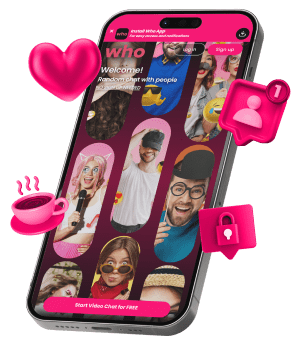
WHO keeps the flow as short as possible. Nothing to fill in when you open it — no username, no email verification, no profile photo. Allow camera access, set your match preferences (including the gender filter for connecting with girls or boys), and tap Start. WHO's matching system finds a verified real user within seconds and the session begins. WHO does not store your video calls. When a session ends the connection is closed permanently and no recording is kept. You stay anonymous to the person you meet, and no profile information is shared during the call.
What makes a random video chat app worth using?
Not every video chat app delivers. The features that separate a platform worth your time from one that wastes it: verified profiles with AI-based human detection before matching; a gender filter that reliably matches you with women; a transparent free access model with no surprise paywall mid-session; proactive rather than reactive moderation; no registration required; mobile availability on iOS and Android; and fast matching with a stable video stream. WHO performs well on all of these, and profile verification is where the gap with other platforms is widest.
Why verified profiles change everything
AI profile verification is a pre-match screening step: before a profile becomes visible to other users, an automated system checks that the account behind it is controlled by a real human. Unlike reactive moderation, which removes bad actors after the fact, AI verification keeps unverified accounts out of the match pool from the start. WHO's approach is different: every profile that enters the match pool has been checked by AI-driven detection confirming a real human is behind it.
WHO vs Omegle, Chatrandom, Chatki, Pink and 1v1
WHO offers AI-verified profiles, a working gender filter, AI moderation, free access, iOS and Android support and no registration. Omegle had no verification, no gender filter, no moderation and no app — it shut down in November 2023. Chatrandom has no verification, partial gender filtering, limited moderation, and its iOS app was removed in 2025. Chatki has no verification, advanced gender filtering and a daily match cap on the free tier. Pink Video Chat has unspecified verification and premium location-based filtering. 1v1 has no verification, no gender filter and weak moderation overall.
WHO as an Omegle alternative
Omegle shut down in November 2023. At the time it was the best-known random chat platform online, and its absence left a real gap for users who wanted a simple, low-friction stranger chat without dating-app mechanics. What users want from an Omegle alternative is the format without the risk: real people, real conversation, no bots, no content they did not sign up for. WHO delivers that directly — no registration, instant matching, AI verification confirming the person you connect to is real.
WHO vs Chatrandom
Chatrandom has been online since 2011 with genuine reach, but profile verification is missing from its matching system. A gender filter exists, but without verified profiles, filtering for girls does not guarantee you connect to a real woman. The system filters claimed gender, not confirmed identity. Chatrandom's iOS app was removed from the App Store in 2025, limiting its reach on mobile.
WHO vs Chatki
Chatki offers gender filtering, regional matching and AI translation, but sets a daily match cap for free users and sells unlimited access through a paid VIP plan. For users who want to explore a platform before paying, that cap matters. WHO has no daily match cap on the core experience.
WHO vs Pink
Pink Video Chat advertises verified users and one-click access, and does it well. The mechanism behind the verification claim is not publicly described, so it is unclear whether AI detection, human review or another system is involved.
WHO vs 1v1
1v1 offers a simple one-to-one match format with minimal setup, but publicly documented moderation is very limited. The differentiator: WHO's verification is named and described as a concrete, checkable claim. Verifying every match as a real human through AI detection is more precise and more verifiable than a general safety assurance.
WHO is free: what to know before you start
WHO is free to use. The platform describes the core experience as completely free: no account, no session time limit, no match cap on the basic experience. That differs from most random video chat platforms, where free means free until you want filters, gender matching or a longer session. On WHO the free experience covers what actually matters: starting a session, matching with verified real users and holding a live video conversation without a timer cutting the call. There is no setup cost, no paywall on the basic gender filter and no countdown clock pushing you to pay. Chatki caps free users daily and then charges monthly to remove the cap. Chatrandom puts advanced gender filters behind a paywall. Pink's location-based matching is premium. WHO's free tier is the actual experience, not a trailer.
How to start a free video call on WHO in 4 steps
Your first session takes under two minutes. Step 1: open WHO at whoapp.live or download the app. WHO works on iOS and Android with no registration. Enable your camera when prompted — that is the only setup step. Step 2: check the home screen for current offers. Step 3: set your match preferences, including the gender filter if you want to match with girls. Step 4: tap Start. WHO connects you to a verified real user within seconds based on your preferences. No waiting room, no loading screen. If the first session is not right, skip immediately — the next match is seconds away.
Live video chat with girls: how WHO handles it
For users who specifically want to connect with girls, the WHO experience rests on two things: a verified gender filter and a verified user pool that contains real women.
Gender filtering: how WHO matches you with real girls
WHO's gender filter lets you set women as your match preference before a session starts. When you tap Start with that preference active, WHO's matching system prioritises verified female users. The key difference from platforms where filtering means little is the verification layer underneath. On unverified platforms, gender filtering sorts claimed identity, not confirmed identity — a fake account can claim any gender. With WHO's AI verification, the women in the match pool are real people confirmed as human before they reach your queue.
Anonymous video chat: privacy and safety on WHO
Anonymity in random video chat is both a feature and a responsibility. As a feature it lowers the barrier to genuine interaction — you can have a real conversation without handing over your identity. As a responsibility it creates conditions that need strong safeguards to be worth it. Staying anonymous on WHO means no profile information is shared with the person you connect to. You do not see their name and they do not see yours. There is no profile page, no social graph, no connection history visible to other users. WHO requires users to be 18 or older. Safety features include: no profile data shared with other users; sessions not recorded or stored after the call ends; AI-driven profile verification filtering out bots before matching; one-tap block and report available at any point during a session; a moderation team reviewing flagged reports; and the 18+ age requirement.
Moderation, reporting and how WHO handles bad actors
WHO's block and report controls are available during any session. You do not have to wait for a situation to escalate. WHO's moderation team reviews flagged reports. That reactive layer works alongside proactive AI verification: bots and fake accounts are filtered before they reach the match pool, and human review handles what slips through. When a session goes badly, use the controls. And whatever the conversation is like, do not share personal contact details with someone you met minutes ago.